Digital Health
Testing and Refining a VR Digital
Therapeutics Platform
A Swiss MedTech company needed its VR therapeutics platform stress-tested before real patients used it. The VR app, its caregiver admin system, and the real-time session monitoring all had to work together without gaps.
The challenge
The client had built a VR-based digital therapeutics platform designed for patients undergoing rehabilitation. Patients wore a VR headset and completed interactive 3D exercises — tasks involving hand tracking, balloon-based movements, and spatial interactions — while caregivers monitored progress through a separate admin dashboard.
The admin dashboard allowed caregivers to configure each session: selecting the environment, background music, and specific exercises. But the dashboard itself was unstable — it had bugs that affected usability, and caregivers could not always rely on it to configure or track sessions correctly. Caregivers also needed a way to follow VR sessions in real time, but true live streaming from the headset was too expensive for the device's hardware constraints.
None of the platform's pieces had been systematically tested together. VR interactions were sometimes inaccurate — hand tracking missed gestures, objects were mis-sized or poorly placed, and exercises did not always behave as designed. Synchronisation between the VR application and the admin dashboard was unreliable. Session configuration changes did not always propagate correctly.
Beyond the application layer, the codebase, CI/CD pipelines, test coverage, and cloud infrastructure all needed attention. As a healthcare product, the platform also had to meet strict data protection standards. The client needed a team that could test hands-on, stabilise what existed, build what was missing, and fix problems across the full stack.
Our approach
We started by putting on the headset. Our team tested every VR exercise first-hand — tracking how the system responded to hand movements, checking whether 3D objects rendered at the correct size and position, and verifying that each exercise scenario played out as intended. We logged every interaction issue, from balloons that failed to register a grab to environments that loaded with incorrect parameters.
We stabilised the existing admin dashboard — fixing bugs, improving usability, and making session configuration reliable. Caregivers could now set up exercises, environments, and music selections and trust that the settings would propagate correctly to the VR headset.
For real-time monitoring, we designed a solution that avoided the cost of live streaming from the VR device. We built a backend infrastructure that captured session data and rendered it in a React-based companion application in a way that closely resembled a real-time stream. Caregivers could follow exercises and patient interactions as they happened — with the quality and responsiveness of a live feed, but without the performance burden on the headset. We resolved synchronisation gaps where session state diverged between the VR app and the companion view, ensuring that what caregivers saw matched what the patient experienced.
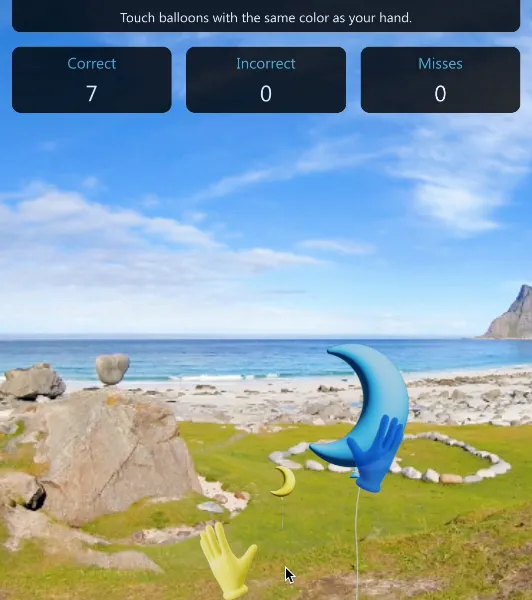
The companion app during a session — caregivers see the exercise type, score, and patient interactions as they happen, powered by the simulated streaming backend.
In parallel, we reviewed the system architecture and DevOps practices. We improved the CI/CD pipelines to catch regressions earlier, expanded automated test coverage across both the VR and admin applications, and hardened the cloud infrastructure. We strengthened data protection measures to align with healthcare regulations — ensuring that patient session data was handled, stored, and transmitted according to the standards the platform required.
The result was a platform where caregivers could configure a session, watch it unfold in real time, and trust that every piece worked together. VR interactions were more accurate, the dashboard was stable, session data flowed reliably end-to-end, and the engineering foundation was ready for production-grade healthcare use.
50+
Issues identified and resolved
Real-time
Caregiver session monitoring
10+
VR exercises tested
100%
Healthcare compliance
Tech stack
Building a digital health product?
We test, refine, and ship healthcare platforms that work in the real world.